How Long Does an Injection Mold Last? Tool Life, Steel Grades, and Maintenance
“How many shots will this mold last?” is one of the first questions buyers ask — and one of the most vaguely answered. The honest answer: injection mold life depends on the steel, the resin, the part geometry, and how well the mold is maintained. Here is how we think about tool life in practice, and the maintenance routine that protects your investment.
Steel Grade Sets the Ceiling
Mold life is largely decided at the steel purchase order:
- Aluminum (7075, QC-10): 5,000–50,000 shots. Prototypes and low-volume work only.
- P20 (pre-hardened, ~30 HRC): 100,000–500,000 shots. The default for most export molds running unfilled resins.
- 718H (improved P20): 300,000–800,000 shots. Better polishability and hardness uniformity.
- H13 (hardened, 48–52 HRC): 1,000,000+ shots. Standard for long-run production and abrasive materials.
- S136 (stainless, 48–52 HRC): 1,000,000+ shots with corrosion resistance — the right choice for PVC, optical parts, and high-polish finishes.
Glass-filled resins are the wildcard. 30% glass fiber can cut tool life by half or more because the glass acts like sandpaper on every cycle. If you plan to run GF-PA or GF-PBT, budget for H13 or S136 from day one — saving money on P20 is a false economy that shows up as flash and dimensional drift within a year.
The Preventive Maintenance Schedule We Follow
A mold is a machine that cycles thousands of times a week. Like any machine, it needs scheduled care:
- Every shift: wipe parting lines, check for flash, verify ejector movement is smooth.
- Every 20,000–50,000 shots: pull the mold, clean vents (clogged vents cause burns and short shots), clean cooling channels, re-lubricate leader pins, ejector pins, and slides.
- Every 100,000 shots: full teardown. Inspect cavity surfaces for wear, check interlocks and wear plates, measure critical dimensions, replace O-rings and springs.
Keep a mold log. Every cleaning, every repair, every shot count. A mold with a documented history is worth real money; a mold with no records is a gamble.
Warning Signs a Mold Needs Attention
Catch these early and you pay for maintenance. Ignore them and you pay for repair:
- Flash appearing where there was none: parting line wear or clamp tonnage no longer sufficient. Do not just raise the clamp force — find the wear.
- Parts sticking or dragging: polish degradation or worn ejection. Continued forcing bends ejector pins.
- Rising cycle time: usually cooling channel scale buildup. A scaled channel can add 20% to cycle time before anyone notices.
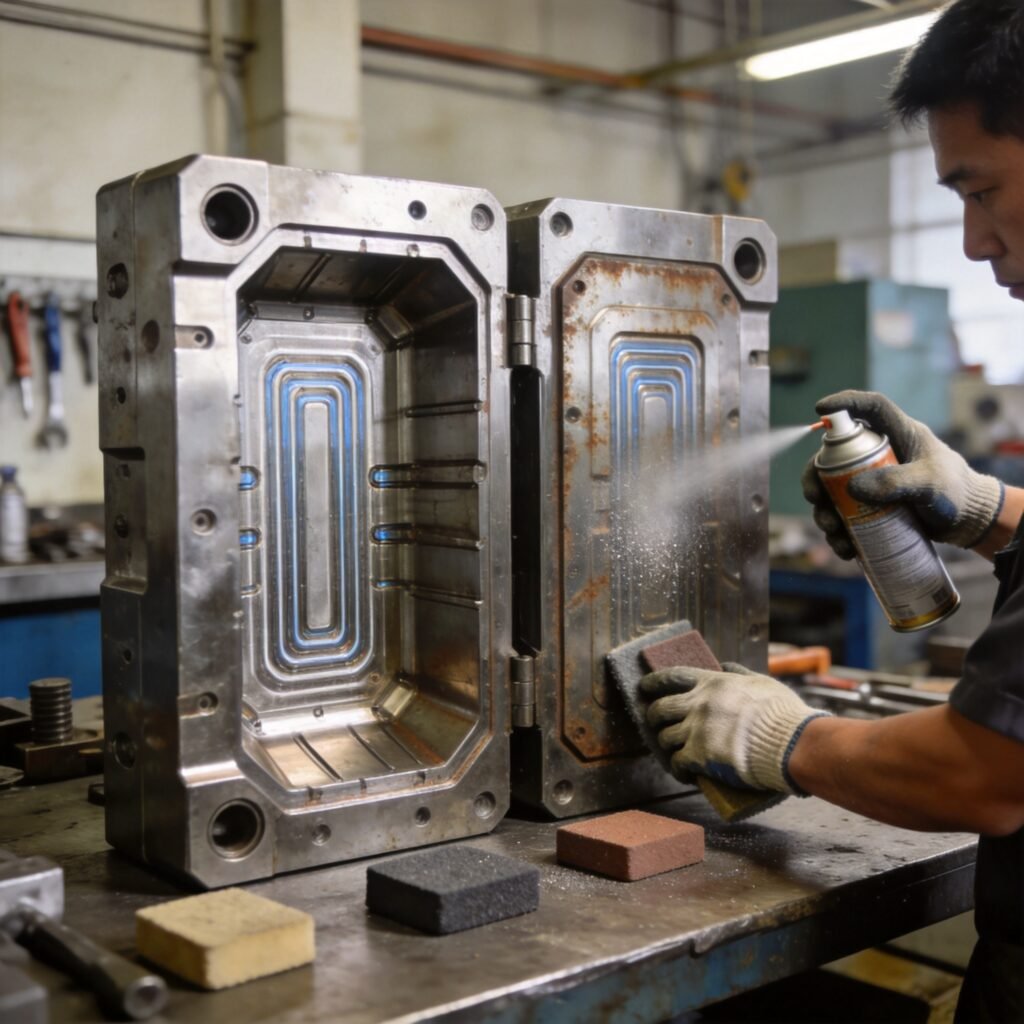
- Rust or water marks: condensation in humid storage. This is why molds ship and store with rust preventive coating.
Storage Matters More Than People Think
Half of the mold damage we repair on tools built elsewhere happened in storage, not in production. Rules are simple: clean, dry, coated with rust inhibitor, stored off the floor, in a climate-stable room. A mold sitting in a humid corner for six months without protection can need a full re-polish before it runs again.
When to Repair vs Replace
Wear plates, springs, O-rings, and ejector pins are consumables — replace them. Eroded gates can often be re-cut or welded and re-machined. But when cavity steel itself is worn past tolerance on a high-precision part, or when the mold needs welding in cosmetic areas, it is time to compare repair cost against a new tool. As a rough guide: if repair exceeds 40% of a new mold’s price, buy new.
Every mold we build ships with a maintenance manual and a recommended service schedule. If your existing tools are underperforming, we also take on mold repair and refurbishment work. Send us the mold photos and history for an assessment.