
VDI 3400 vs SPI vs Mold-Tech: How to Specify the Right Mold Surface Finish
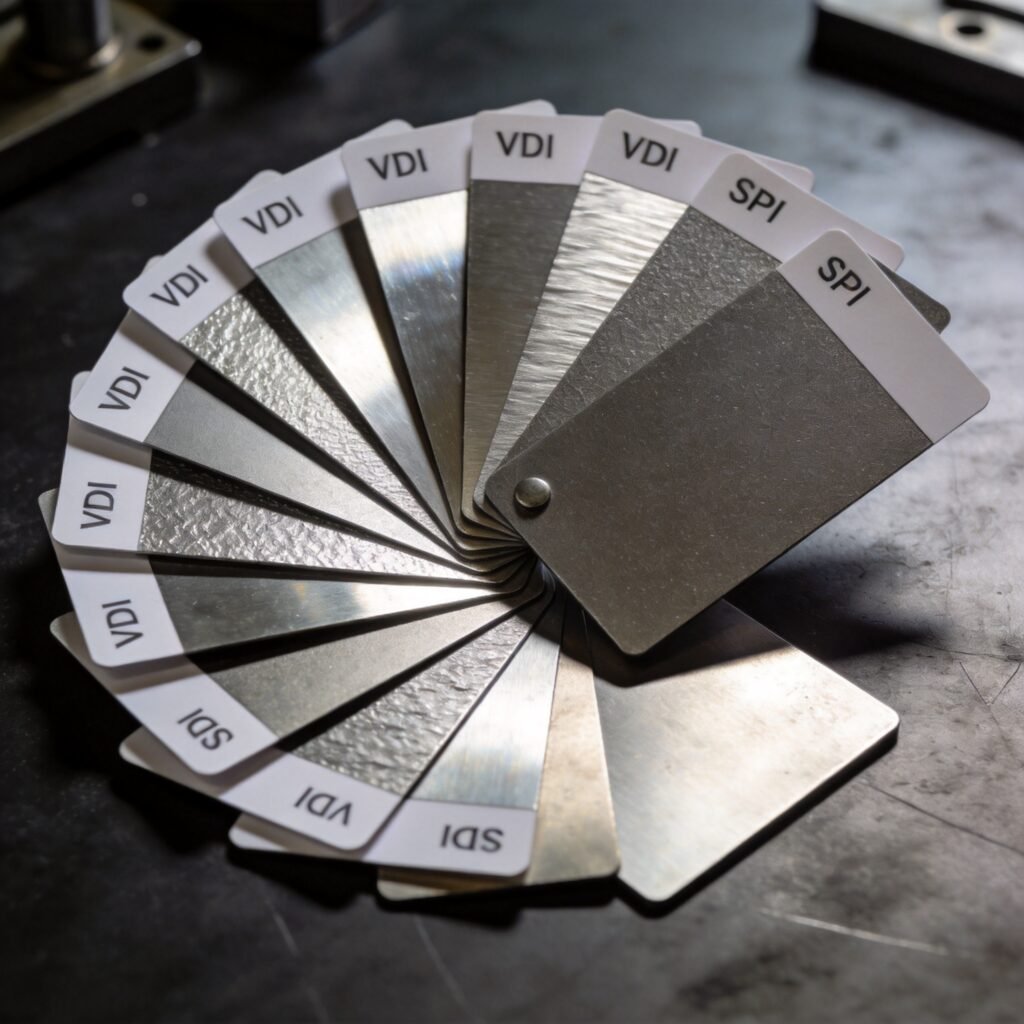
“Make the surface matte” is not a specification. We have seen projects delayed for weeks because a drawing said “textured” and the customer expected a fine VDI 21 grain while the toolmaker cut a heavy leather texture. If you want the right mold surface finish, you need to name the standard and the grade. Here is how the three most common systems compare.
SPI Finish (A1–D3): The Polishing Standard
The SPI surface finish scale (from the Society of the Plastics Industry, now PLASTICS) defines twelve grades in four groups, based on how the steel is polished:
- A1–A3: mirror polish, diamond buff. Used for lenses, optical parts, high-gloss cosmetic housings. A1 is a true #3 diamond mirror — expensive to achieve and to maintain.
- B1–B3: semi-gloss, sandpaper polish. Common for visible consumer parts that should look smooth but not mirror-like.
- C1–C3: matte stone polish. Hides fingerprints and minor flow marks; a workhorse for industrial housings.
- D1–D3: dry-blast finish (glass bead or aluminum oxide). Dull, grippy, and the cheapest to apply.
SPI grades tell the polisher how to work the steel — they are not textures in the patterned sense.
VDI 3400 (VDI 0–45): The EDM Texture Standard
VDI 3400 grades describe the surface left by EDM (electrical discharge machining). Each number corresponds to a defined roughness: VDI 12 is fine (Ra ~0.4 µm), VDI 45 is coarse (Ra ~18 µm). Even if your cavity is milled rather than EDMed, VDI numbers are widely used to specify bead-blasted or chemically etched finishes because the grades are standardized and comparable worldwide.
- VDI 12–21: fine, satin-like finish. Good for visible parts, low gloss.
- VDI 24–33: medium grain, common on interior automotive and appliance parts.
- VDI 36–45: heavy grain — hides defects well but looks and feels coarse.
Important: VDI numbers differ between EDM machine makers. Charmilles VDI 24 is not identical to Sodick VDI 24, which is why physical reference plates matter more than paper specs.
Mold-Tech (MT Series): Patterned Textures
Mold-Tech texture codes (MT-11010, MT-11020, and so on) are chemically etched patterns — leather grain, geometric patterns, wood grain — applied by licensed texture shops. The pattern is etched into the steel to a controlled depth, typically 0.05–0.15 mm.
- Textures below ~0.1 mm depth need 1° of draft per 0.025 mm of texture depth — a deep texture on a vertical wall without draft will drag and scuff on ejection.
- MT textures are excellent for hiding sink marks and weld lines on cosmetically sensitive parts.
- Etching is one-way: removing texture means re-polishing the cavity. Texturing is scheduled after the mold is proven dimensionally.
How to Specify Finish So You Get What You Expect
- Name the standard and grade on the drawing: “VDI 24, all A-surfaces” or “SPI B-2”.
- Approve a physical sample. Ask for the actual texture card or steel plate — the grade numbers only take you so far. We supply VDI, SPI, and Mold-Tech comparison cards and plates for exactly this reason.
- Mark texture boundaries on the 2D drawing. Different finishes on one part (gloss logo area, matte body) need clear limits.
- Check draft before approving texture. Deep texture + zero draft = ejection damage.
- Agree on gloss measurement. For critical parts, specify a gloss-meter range at 60°, not just a grade name.
Quick Selection Guide
- High-gloss cosmetic part → SPI A-2/A-3
- General consumer housing → SPI B-1 or VDI 21
- Fingerprint-prone black plastic → SPI C-1 or VDI 24–27
- Hide sink/weld defects → Mold-Tech medium grain
- Non-slip grip → SPI D-2/D-3 or VDI 36+
Not sure which standard fits your part? Send us the application and a photo of a finish you like — we will match it to a grade and mail you a physical texture card before your tool is textured.